
AMYLOID FIBRILS
The accumulation of proteins within ordered amyloid fibrils is a defining feature of many neurodegenerative and systemic amyloid diseases. Although these fibrils share common structural properties, the pathways that generate them and their effects on cells differ across proteins and tissues. We investigate fibril formation as a dynamic process shaped by metabolism, molecular interactions and cellular environment.
ALPHA-SYNUCLEIN: MEMBRANE BINDING AND FIBRILIZATION
Alpha-synuclein is an intrinsically disordered protein whose structure and function are strongly influenced by its molecular environment. In Parkinson’s disease and related synucleinopathies, alpha-synuclein misfolds and accumulates, yet this process cannot be understood independently of the metabolic and membrane contexts in which the protein normally functions. We therefore investigate how cellular metabolism and membrane composition regulate alpha-synuclein binding, structure, localization and assembly across physiological and pathological states.
Cardiolipin (CL) and phosphatidic acid (PA) provide distinct anionic membrane environments that influence alpha-synuclein conformation, but they represent components of a broader membrane-binding program rather than its complete scope. Our work defines the membrane properties that favour physiological binding or promote a partially bound state in which the N-terminus remains membrane-bound while the NAC domain is released and exposed, thereby favouring fibril seeding. We then determine how these membrane-associated states influence aggregation, fibril remodelling and cellular propagation in human neuronal models, including the use of lipid nanoparticles to destabilize or dissolve fibrillar alpha-synuclein deposits. Together, this work positions metabolism and membranes as active regulators of alpha-synuclein biology rather than passive settings in which aggregation occurs.
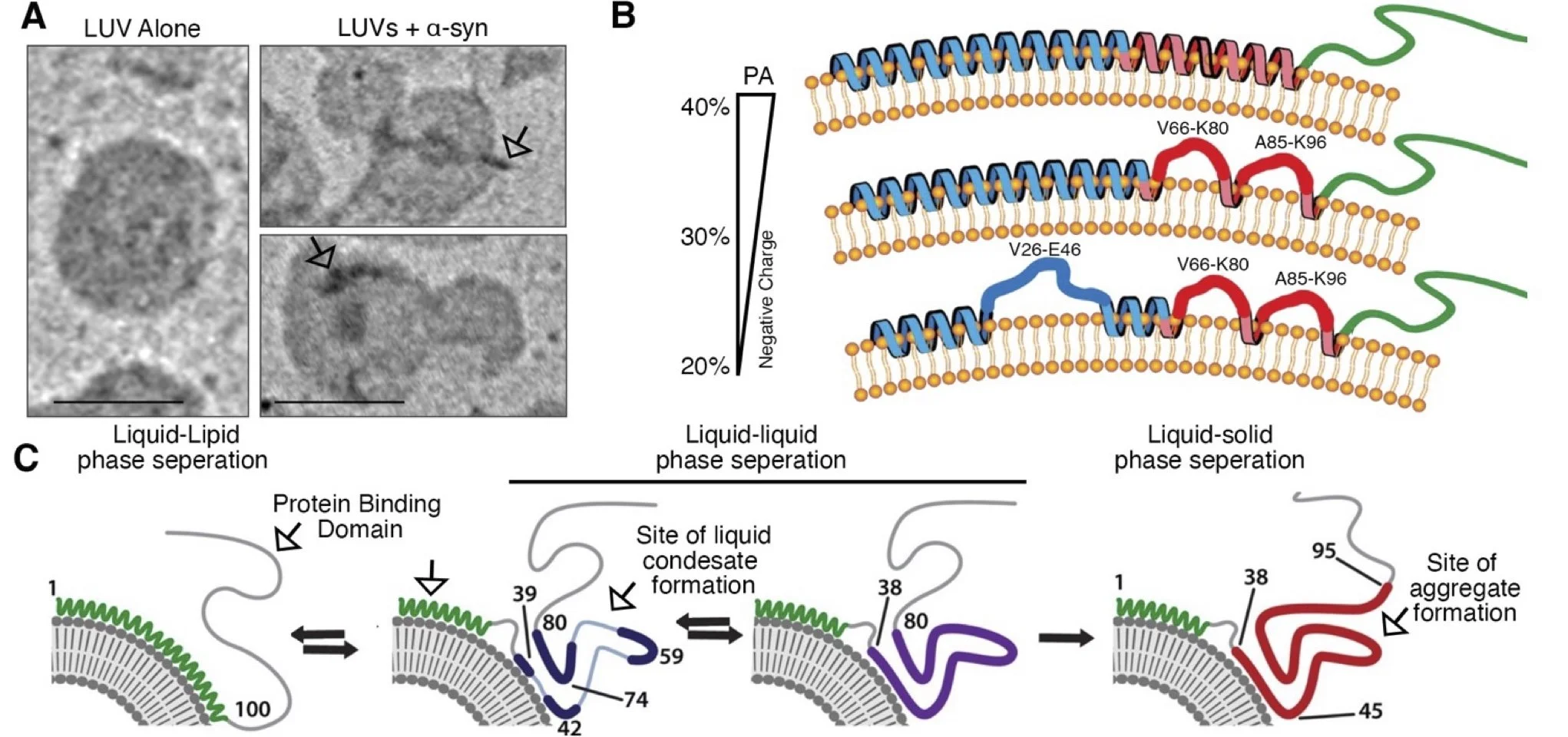
Alpha-synuclein condensates form on the surface of lipid membranes in response to changes in lipid dynamics. (A) TEM images of alpha-synuclein with large unilamellar vesicles (LUVs) show accumulation of the protein at the vesicle surface. (B) Solid-state NMR with increasing phosphatidic acid (PA) indicates that high-affinity membrane interactions are concentrated within the N-terminal region. (C) Proposed model in which membrane binding drives a transition from liquid–lipid to liquid–liquid phase separation and ultimately liquid–solid aggregation; bold segments indicate potential beta-folds.
TAU FIBRILS
Tau normally supports the organization and stability of neuronal microtubules. In tauopathies, changes in tau structure and modification promote its release from microtubules, misfolding and assembly into amyloid fibrils. Although tau fibrils are a defining pathological feature, the molecular events that initiate their formation and determine their structural properties remain incompletely resolved.
We investigate tau fibrillization in complex amyloid environments in which tau assembly is seeded by alpha-synuclein. This approach allows us to determine how cross-seeding regulates fibril growth and produces structural or material states that are shared across amyloid proteins or specific to tau. We then connect these assembly states to cellular homeostasis and neuronal function, distinguishing the effects of soluble tau, intermediate assemblies and mature fibrils rather than treating all aggregated states as equivalent. Collectively, this work defines how alpha-synuclein influences the molecular progression of tau fibrillization and how the resulting assemblies disrupt neuronal biology.
TRANSTHYRETIN FIBRILS
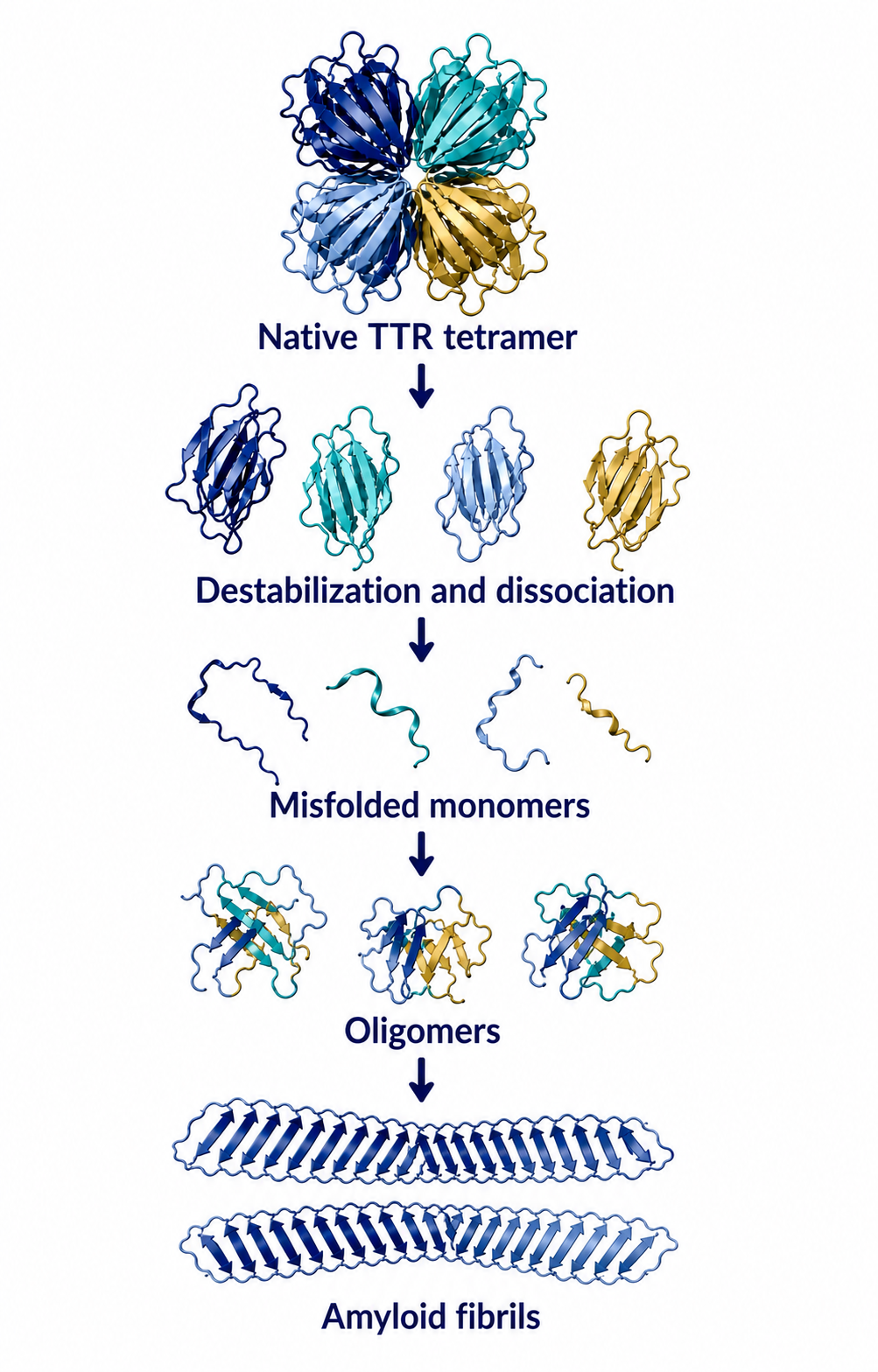
Transthyretin (TTR) is a transport protein whose native stability is essential to its physiological function. When TTR destabilizes, it can misfold and assemble into amyloid fibrils that accumulate in tissues and contribute to hereditary or age-associated disease. TTR therefore provides a complementary system for determining which principles of amyloid formation are general and which depend on the structure, normal function and tissue context of the aggregating protein.
We investigate the molecular conditions that destabilize native TTR, promote the accumulation of monomers and oligomers, and initiate fibril nucleation and growth. Defining this progression may also establish whether non-native TTR species in blood can support earlier diagnosis. Comparing TTR assemblies with alpha-synuclein and tau identifies shared structural principles while preserving the distinct biological context of ATTR amyloidosis. This program makes TTR a mechanistic bridge between amyloid biophysics, neural development and tissue-specific cardiac disease.